Tulsidas

About Tulsidas

Tulsidas also known as Goswami Tulsidas; 1497/1532–1623) was a Hindu poet-saint, reformer and philosopher renowned for his devotion to the god Rama. A composer of several popular works, he is best known as the author of the epic Ramcharitmanas, a retelling of the Sanskrit Ramayana in the vernacular Awadhi. Tulsidas was acclaimed in his lifetime to be a reincarnation of Valmiki, the composer of the original Ramayana in Sanskrit. He is also considered to be the composer of the Hanuman Chalisa, a popular devotional hymn dedicated to Hanuman, the divine devotee of Rama. Tulsidas spent most of his life in the city of Varanasi. The Tulsi Ghat on the Ganges River in Varanasi is named after him. He founded the Sankatmochan Temple dedicated to Hanuman in Varanasi, believed to stand at the place where he had the sight of Hanuman. Tulsidas started the Ramlila plays, a folk-theatre adaption of the Ramayana. He has been acclaimed as one of the greatest poets in Hindi, Indian, and world literature. The impact of Tulsidas and his works on the art, culture and society in India is widespread and is seen to date in vernacular language, Ramlila plays, Hindustani classical music, popular music, and television series.

Early life

Tulsidas was born on saptami, the seventh day of shukla paksha, the bright half of the lunar Hindu calendar month Shraavana (July–August). Although as many as seven places are mentioned as his birthplace, most scholars identify the place with Rajapur (Chitrakuta), a village on the banks of the Yamuna river in modern-day Uttar Pradesh. His parents were Hulsi and Atmaram Dubey. Most sources identify him as a Saryupareen Brahmin of the Parashar Gotra (lineage), although some sources claim he was a Kanyakubja or Sanadhya Brahmin.

There is difference of opinion among biographers regarding the year of birth of Tulsidas. Many sources rely on Veni Madhav Das' account in the Mula Gosain Charita, which gives the year of Tulsidas' birth as Vikrami Samvat 1554 (1497 CE). These sources include Shivlal Pathak, popular editions of Ramcharitmanas (Gita Press, Naval Kishore Press and Venkateshvar Press), Edwin Greaves, Hanuman Prasad Poddar, Ramanand Sarasvati, Ayodhyanath Sharma, Ramchandra Shukla, Narayandas, and Rambhadracharya. A second group of biographers led by Sant Tulsi Sahib of Hathras and Sir George Grierson give the year as Vikram 1589 (1532 CE). These biographers include Ramkrishna Gopal Bhandarkar, Ramghulam Dwivedi, James Lochtefeld, Swami Sivananda and others. A third small group of authors which includes H. H. Wilson, Garse De Tasse and Krishnadatta Mishra gives the year as Vikram 1600 (1543 CE).

The year 1497 appears in most current-day biographies and in popular culture. Biographers who disagree with this year argue that it makes the life span of Tulsidas equal 126 years, which in their opinion is unlikely if not impossible. In contrast, Ramchandra Shukla says that an age of 126 is not impossible for Mahatmas (great souls) like Tulsidas. The Government of India and provincial governments celebrated the 500th birth anniversary of Tulsidas in the year 1997 CE, according to the year of Tulsidas' birth in popular culture.

Jalaram

About Jalaram

Jalaram popularly known as Jalaram Bapa (4 November 1799 – 23 February 1881) was a Hindu saint from Gujarat, India. He was born on 4 November 1799, one week after the Hindu festival of Diwali, which is associated with his Iṣṭa-devatā Lord Rama.

Life

Jalaram Bapa was born in Virpur, Rajkot district, Gujarat, India in 1799, on the seventh day of the Kartika month. His father was Pradhan Thakkar and his mother was Rajbai Thakkar who belonged to Thakkar clan, which is a sub-group of Lohana clan. He was a devotee of the Hindu god Rama.

Jalaram Bapa was however not willing to live an householder's life and continued to take care of his fathers business. He was mostly engaged in serving pilgrims, sadhus and saints. He separated himself from his father's business and his uncle Valjibhai asked Jalaram Bapa and his wife Virbai to stay in his house.

At the age of sixteen, in 1816, Jalaram married Virbai, the daughter of Pragjibhai Thakkar (Somaiya) of Atkot. However, he was inclined to completely withdraw from materialistic life and become an ascetic, Virbai proved to be an asset to him in his works of feeding poor and needy.

At the age of 18, soon after returning from pilgrimage to Hindu holy places, Jalaram Bapa became the disciple of Bhoja Bhagat of Fatehpur, who accepted him as his disciple. Jalaram was given the "Guru Mantra" (mantra) and japa mala in the name of Rama by his Guru Bhojalram. With blessings of his guru, he started "Sadavrat", a feeding center, a place where all sadhus and saints as well as the needy could have food any time.

One day, a sadhu who came to his house gave him an idol of Rama, forecasting that Hanuman, the monkey-god and devotee of Rama, would follow soon. Jalaram Bapa installed Rama as his family deity and after a few days, an idol of Hanuman appeared out of earth, on its own. The idol of Rama's consort Sita and his brother Lakshmana also appeared. Due to a miracle the container in the house of Jalaram, where grains were stored, became inexhaustible. Later other devotees and village folk joined him in his works of human welfare.

Soon his fame spread as an divine incarnation. Whoever came to Virpur, whether Hindu or Muslim irrespective of caste, creed and religion were fed by Jalaram. This tradition of feeding people continues to this day in Virpur.

Once a tailor named Haraji, who was suffering from severe stomach-ache came to him to get himself cured. Jalaram Bapa prayed to God and Haraji was cured. He fell at Jalaram Bapa 's feet and addressed him as Bapa. Since then he was known as Jalaram Bapa. Soon his fame spread and people came to him to get rid of diseases and problems. Jalaram Bapa would pray for them in the name of Rama and miracles happened. Both Hindus and Muslims became his disciples. In 1822, Jamal, son of a rich Muslim merchant fell ill and doctors gave up all hope. At that point of time, Haraji, told Jamal of his experience (parcha). Jamal, prayed from his house, that if his son is cured of the disease, he would give 40 maunds of grain to Jalaram Bapa for sadavrat. His son recovered and Jamal visited house of Jalaram Bapa with cart load of grains and called him Jalla so Allah!!.

At one time, God in the guise of an old saint told Jalaram to send Virbai to serve him. Jalaram consulted her and with her consent sent her with the saint. But after walking some miles and reaching a nearby forest, the saint asked Virbai to wait for him. She waited but saint did not return. Instead, she heard an Akashwani stating that it was only to test the hospitality of the couple. Before the saint disappeared, he left a Danda and Jholi [Cloth bag], with Virbai. Virbai returned home to Jalaram, as instructed by the celestial voice with Danda & Jholi. This Danda and Jholi are still at Virpur and kept on display in a glass enclosure.

Vallabha Acharya

About Vallabha Acharya

Vallabhacharya (1479–1531 CE) was a devotional philosopher, who founded the Pushti sect in India, following the philosophy of Shuddha advaita.

Vallabhacharya accepted the 'Acharya' designation of Vishnuswami Sampraday (Rudra Sampraday) upon request of Bilvamangala Acharya, the last Vishnuswami Sampraday acharya before Vallabhacharya. This was after Vallabhacharya won the famous debate of Brahmavada over Shankaras in the courtyard of the Emperor Krishna Deva Raya of Vijayanagara Empire — the prosperous South Indian Empire. Apart from being the acharya of Vishnuswami Sampradaya, Vallabhacharya also propagated the Pushtimarga upon the god Krishna's order and thus became the acharya of not only Vishnuswami Sampradaya but also Pushti Sampradaya.

He is the Acharya and Guru within the Vaishnava traditions as promulgated and prescribed by the Vedanta philosophy. He is associated with Vishnuswami, a prominent Acharya of Rudra Sampradaya out of the four Vaishnava Sampradayas.

Within Indian Philosophy, he is known as the writer of Anubhashya (a commentary on Brahm Sutra), Shodash Granth or sixteen 'stotras' (tracts) and several commentaries on the Bhagavata Purana, which describes the many lilas (pastimes) of the Avatar, Krishna. Vallabhaacharya occupies a unique place in Indian culture as a scholar, a philosopher and devotional (bhakti) preacher. He is widely considered as the last of the four great Vaishnava Acharyas who established the various Vaishnava schools of thought based on Vedantic philosophy, the other three (preceding him) being Ramanujacharya, Madhvacharya and Nimbarkacharya. He is especially known as a lover and a propagator of Bhagavata Dharma. He was born in Champaranya in India.

Life

The ancestors of Vallabhacharya lived in Andhra Pradesh and belonged to a long line of Telugu Vaidiki Brahmins known as Vellanadu or Vellanatiya following the Vishnu Swami school of thought. According to devotional accounts, Krishna commanded his ancestor Yagnanarayana Bhatta that He would take birth in their family after completion of 100 Somayagnas (fire sacrifices). By the time of Yagnanarayana's descendant Lakshmana Bhatta who migrated to the holy town of Varanasi, the family had completed 100 Somayagnas. Vallabhacharya was born to Lakshmana Bhatta in 1479 A.D. (V.S. 1535) on the 11th day of the dark half of lunar month of chaitra at Champaranya. The name of his mother was Illamma.

The period surrounding Vallabhacharya's birth was a tumultuous one and most of northern and central India was being influenced by Muslim invaders. It was common for populations to migrate in order to flee from religious persecution and conversion. On one such occasion, Lakshmana Bhatta had to urgently move out of Varanasi with his pregnant wife. Due to terror and physical strain of the flight suffered by the mother, there was a premature birth of the child, two months in advance. As the child did not show signs of life, the parents placed it under a tree wrapped in a piece of cloth. It is believed that Krishna appeared in a dream before the parents of Vallabhacharya and signified that He Himself had taken birth as the child. According to popular accounts, the parents rushed to the spot and were amazed to find their baby alive and protected by a circle of divine fire. The blessed mother extended her arms into the fire unscathed; she received from the fire the divine baby, gleefully to her bosom. The child was named Vallabha (meaning "dear one" in Sanskrit).

Vivekananda

About Vivekananda

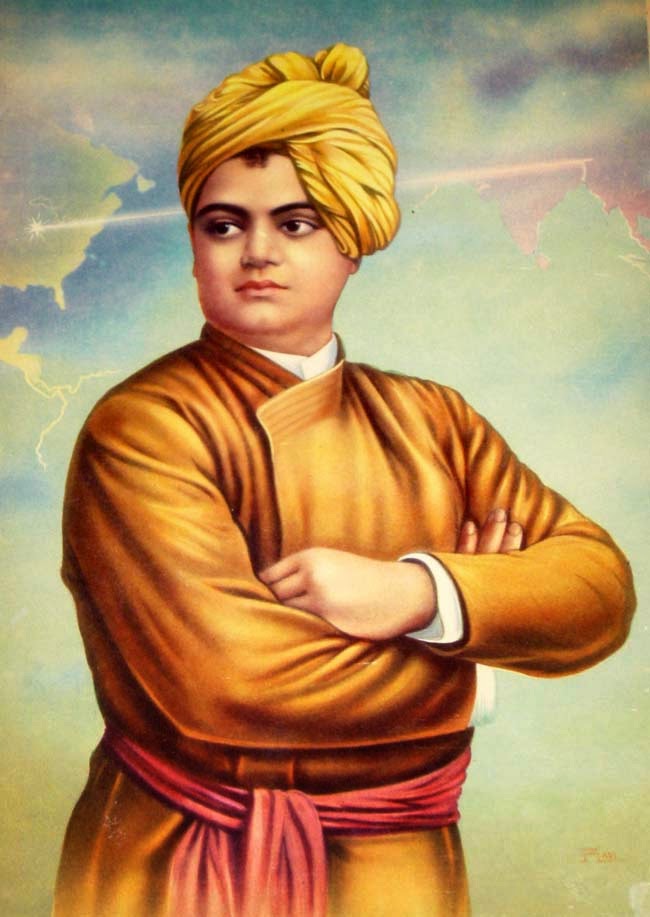
Swami Vivekananda (Bengali: [Bibekanɒnɖo] (12 January 1863 – 4 July 1902), was an Indian Hindu monk and chief disciple of the 19th-century saint Ramakrishna. He was a key figure in the introduction of the Indian philosophies of Vedanta and Yoga to the Western world and is credited with raising interfaith awareness, bringing Hinduism to the status of a major world religion during the late 19th century. He was a major force in the revival of Hinduism in India, and contributed to the concept of nationalism in colonial India. Vivekananda founded the Ramakrishna Math and the Ramakrishna Mission. He is perhaps best known for his inspiring speech which began, "Sisters and brothers of America ...," in which he introduced Hinduism at the Parliament of the World's Religions in Chicago in 1893.

Born into an aristocratic Bengali family of Calcutta, Vivekananda was inclined towards spirituality. He was influenced by his guru, Ramakrishna, from whom he learnt that all living beings were an embodiment of the divine self; therefore, service to God could be rendered by service to mankind. After Ramakrishna's death, Vivekananda toured the Indian subcontinent extensively and acquired first-hand knowledge of the conditions prevailing in British India. He later travelled to the United States, representing India at the 1893 Parliament of the World Religions. Vivekananda conducted hundreds of public and private lectures and classes, disseminating tenets of Hindu philosophy in the United States, England and Europe. In India, Vivekananda is regarded as a patriotic saint and his birthday is celebrated as National Youth Day in India.

Early life (1863–1888)

Vivekananda was born Narendranath Datta (shortened to Narendra or Naren) at his ancestral home at 3 Gourmohan Mukherjee Street in Calcutta, the capital of British India, on 12 January 1863 during the Makar Sankranti festival. He belonged to a traditional Bengali Kayastha family and was one of nine siblings. His father, Vishwanath Datta, was an attorney at the Calcutta High Court Durgacharan Datta, Narendra's grandfather, was a Sanskrit and Persian scholar who left his family and became a monk at age twenty-five. Narendra's mother, Bhuvaneswari Devi, was a devout housewife. The progressive, rational attitude of Narendra's father and the religious temperament of his mother helped shape his thinking and personality.

Narendra was interested in spirituality from a young age, and used to play at meditating before the images of deities such as Shiva, Rama, and Sita. He was fascinated by wandering ascetics and monks. Narendra was naughty and restless as a child, and his parents often had difficulty controlling him. His mother said, "I prayed to Shiva for a son and he has sent me one of his demons".
Education

In 1871 Narendra enrolled at Ishwar Chandra Vidyasagar's Metropolitan Institution, where he studied until his family moved to Raipur in 1877. In 1879, after his family's return to Calcutta, he received first-division marks in the Presidency College entrance examination. That year, he was the only student at his college who received first-division marks. Narendra was an avid reader and was interested in a wide range of subjects, including philosophy, religion, history, social science, art and literature. He was also interested in Hindu scriptures, including the Vedas, the Upanishads, the Bhagavad Gita, the Ramayana, the Mahabharata and the Puranas. Narendra was trained in Indian classical music, and regularly participated in physical exercise, sports and organised activities.

Narendra studied Western logic, Western philosophy and European history at the General Assembly's Institution (now known as the Scottish Church College). In 1881 he passed the Fine Arts examination, and completed a Bachelor of Arts degree in 1884. Narendra studied the works of David Hume, Immanuel Kant, Johann Gottlieb Fichte, Baruch Spinoza, Georg W. F. Hegel, Arthur Schopenhauer, Auguste Comte, John Stuart Mill and Charles Darwin. He became fascinated with the evolutionism of Herbert Spencer and corresponded with him, translating Spencer's book Education (1861) into Bengali. While studying Western philosophers, he also learned Sanskrit scriptures and Bengali literature. William Hastie (principal of General Assembly's Institution) wrote, "Narendra is really a genius. I have travelled far and wide but I have never come across a lad of his talents and possibilities, even in German universities, among philosophical students". Some accounts have called Narendra a srutidhara (a person with a prodigious memory).

Tukaram

About Tukaram

Sant Tukaram (1577–1650) was a prominent Varkari Sant and spiritual poet of the Bhakti. He is often referred to with an honorific, Sant Tukaram. Sant Tukaram was a devotee of Vitthala or Vithoba, a form of God Vishnu.

Contribution To The Bhakti Movement

Sant Tukaram is considered as one of the most important saints of the Bhakti Movement. The Bhakti Movement which spread across India and many other saints of his generation were active in challenging this set-up.

The Indian subcontinent had prospered culturally for many centuries, with the most prominent eras being 500 BC to 1000 AD. The Indian subcontinent enjoyed an upsurge in education, scientific and philosophical introspection. Not only this, every aspect of the society prospered including, establishing trade relations with countries like Greece, Iran and China. But after 1000 AD, the society went downhill, there was widespread disparity, "caste practices" and other social evils began in this era. Brahmins made education inaccessible to other classes of the society. Orthodox practices and rituals were used as tools for dominating others. Since caste system placed "Brahmins" in position of teaching, all rights towards education and ultimately towards "finding God" were owned by Brahmins. This led to "untouchability"

Circumstances reached a climactic point were the society was facing evils due to Brahmin domination as well as there were many foreign invasions that were changing and challenging the known worldview for the contemporary people. It is during this time that, what constitutes the Bhakti Movement began to take shape across the many parts of the country.

One of the prominent saint of the Bhakti Movement is Sant Tukaram. He had a great understanding of Hindu philosophy and wrote many songs in praise of God Vitthal, revered as an incarnation of Vishnu. The Brahmins of his village Dehu were deeply offended by this act of pursuing God by a non-Brahmin. They challenged his interpretation of the Vedas and Puranas and tried to destroy the abhang songs written by him. According to Sant Tukaram, there is no reference of any caste hierarchy mentioned in the Vedas. This opinion became very popular.He sang it in the form of abhangs.

His abhangs had themes varying from humility, equality, concern for ecology and God's Grace, were sung and recorded in his name.

Dilip Purushottam Chitre, a well known Marathi Scholar, identifies Tukaram as the first modern poet of Marathi. Chitre believes that Tukaram was the successor to Dnyaneshwar who denied caste hierarchy in Hindu religion and attacked rituals present in Hinduism. Tukaram has attacked almost every form of myth existing in Hindu society during his time. He opposed the existing system of humans by misunderstanding chaturvarna in the Vedas as untouchability or divisions of politics.

Sai Baba of Shirdi

About Sai Baba of Shirdi

Sai Baba of Shirdi (unknown – 15 October 1918), also known as Shirdi Sai Baba, was a spiritual master who was and is regarded by his devotees as a saint, fakir, avatar (an incarnation of God), or sadguru, according to their individual proclivities and beliefs. He was revered by both his Muslim and Hindu devotees, and during, as well as after, his life on earth it remained uncertain if he was a Muslim or Hindu himself. This however was of no consequence to Sai Baba himself. Sai Baba stressed the importance of surrender to the guidance of the true Sadguru or Murshad, who, having gone the path to divine consciousness himself, will lead the disciple through the jungle of spiritual training.

Sai Baba remains a very popular saint, especially in India, and is worshiped by people around the world. He had no love for perishable things and his sole concern was self-realization. He taught a moral code of love, forgiveness, helping others, charity, contentment, inner peace, and devotion to God and guru. He gave no distinction based on religion or caste. Sai Baba's teaching combined elements of Hinduism and Islam: he gave the Hindu name Dwarakamayi to the mosque he lived in, practised Muslim rituals, taught using words and figures that drew from both traditions, and was buried in Shirdi. One of his well known epigrams, "Sabka Malik Ek" ("One God governs all"), is associated with Islam and Sufism. He also said, "Trust in me and your prayer shall be answered". He always uttered "Allah Malik" ("God is King").

Early years

Historians and devotees agree that there is no reliable evidence for a particular birthplace or date of birth. Communities have claimed that he belongs to them, but nothing has been substantiated. It is known that he spent considerable periods with Muslim fakirs, and his attire resembled that of a fakir. He did not discriminate based on religion and respected all forms of worship to God.

Little has been officially documented on the early life of Shirdi Sai Baba. An account of Shirdi Sai's missing childhood years has been reconstructed by his disciple Das Ganu, after researching in the area around the village of Pathri. He collected this story in four chapters on Sai Baba, later also called the Sri Sai Gurucharitra.[8][9] Das Ganu states that Sai Baba grew up in Pathri, with a fakir and his wife. At the age of five, says Das Ganu, the fakir's wife put him in the care of the saintly desmukh Venkusha, where the boy stayed several years. Dasganu calls the young Sai Baba the reincarnation of Kabir. Because Das Ganu was known to take poetic liberties when telling stories about Sai Baba, and as there are no other sources to corroborate this story, it usually is left out of biographies of Sai Baba of Shirdi.

Sai Baba's biographer Narasimha Swamiji claims that Sai Baba was born as the child of Brahmin parents:

"On one momentous occasion, very late in his life, he revealed to Mhalsapathy the interesting fact that his parents were Brahmins of Patri in the Nizam's State. Patri is part of Parvani taluk, near Manwath. Sai Baba added, in explanation of the fact that he was living in a Mosque, that while still a tender child his Brahmin parents handed him over to the care of a fakir who brought him up. This is fairly indisputable testimony, as Mahlsapathy was a person of sterling character noted for his integrity, truthfulness and vairagya." —Narasimha Swamiji, Life of Sai Baba

According to the book Sai Satcharita, Sai Baba arrived at the village of Shirdi in the Ahmednagar District of Maharashtra, British India, when he was about 16 years old. He led an ascetic life, sitting motionless under a neem tree and meditating while sitting in an asana. The Shri Sai Satcharita recounts the reaction of the villagers:

The people of the village were wonder-struck to see such a young lad practicing hard penance, not minding heat or cold. By day he associated with no one, by night he was afraid of nobody.

His presence attracted the curiosity of the villagers, and he was regularly visited by the religiously inclined, including Mahalsapati, Appa Jogle and Kashinatha. Some considered him mad and threw stones at him. Sai Baba left the village, and little is known about him after that. However, there are some indications that he met with many saints and fakirs, and worked as a weaver. He claimed to have been with the army of Rani Lakshmibai of Jhansi during the Indian Rebellion of 1857. It is generally accepted that Sai Baba stayed in Shirdi for three years, disappeared for a year, and returned permanently around 1858, which suggests a birth year of 1838.